
Real Estate Lawyer Disbursements in Ontario: What Each One Costs
Real estate lawyer disbursements are third party costs that your lawyer pays to complete your transaction. The legal fee covers the firm's own work.…


If you are buying or selling a home, real estate lawyer fees in Ontario are one closing cost you cannot skip — the law requires a lawyer to complete every property transfer in the province. Yet the final bill is one of the most misunderstood numbers in the whole process. A quote that looks cheap on the surface can grow by hundreds of dollars by closing day, while a higher headline number sometimes turns out to be the better deal. This guide breaks down exactly what you are paying for in 2026, so there are no surprises on your Statement of Adjustments.
Every real estate closing splits into two very different categories, and confusing them is where most budgeting mistakes happen.
The legal fee is what your lawyer charges for their professional time, judgment and responsibility: reviewing your Agreement of Purchase and Sale, running title and writ searches, preparing closing documents, dealing with the other side’s lawyer and your lender, and registering the transfer. Harmonized Sales Tax (HST) of 13% applies on top of this fee.
Disbursements are out-of-pocket costs your lawyer pays to third parties on your behalf and passes straight through to you — things like government registration charges, search fees and title insurance. They are not profit for the firm. A good quote shows the legal fee and the disbursements as separate lines, so you can see the all-in number rather than just the headline.
For a standard residential transaction, purchases cost more than sales because they involve mortgage review, title and writ searches, and lender communication. A condominium purchase usually sits at the higher end, because it requires a condo status certificate review that a freehold house does not.
Almost every residential file in Ontario is quoted as a flat fee, which most buyers and sellers prefer because it makes closing costs predictable. Hourly billing is rare and usually reserved for commercial or contested files. Whatever the structure, always get the quote in writing — the Law Society of Ontario requires a written retainer that sets out the scope and the price.
There is an important consumer protection worth knowing here. Under the Law Society of Ontario’s advertising rules (Rule 4.2-2.1), if a firm advertises a fixed price to act on a residential real estate transaction, that price must be all-inclusive. It has to cover all legal fees, disbursements and third-party charges, with only a short, defined list of permitted exclusions — HST, land transfer tax, government registration and Teranet fees, the cost of a condominium status certificate, execution (creditor) letters, and any title insurance premium. Those exclusions cannot be buried in small print or on a separate page. In other words, a genuinely transparent flat fee is not a courtesy some firms offer; for advertised prices it is a professional obligation. A quote that ignores this is a red flag.
On a typical residential purchase, disbursements add roughly $500 to $1,000 on top of the legal fee. The most common ones include:
Because firms differ in what they bundle into the fee versus bill as a disbursement, the same closing can be quoted at very different headline prices. What matters is the total.
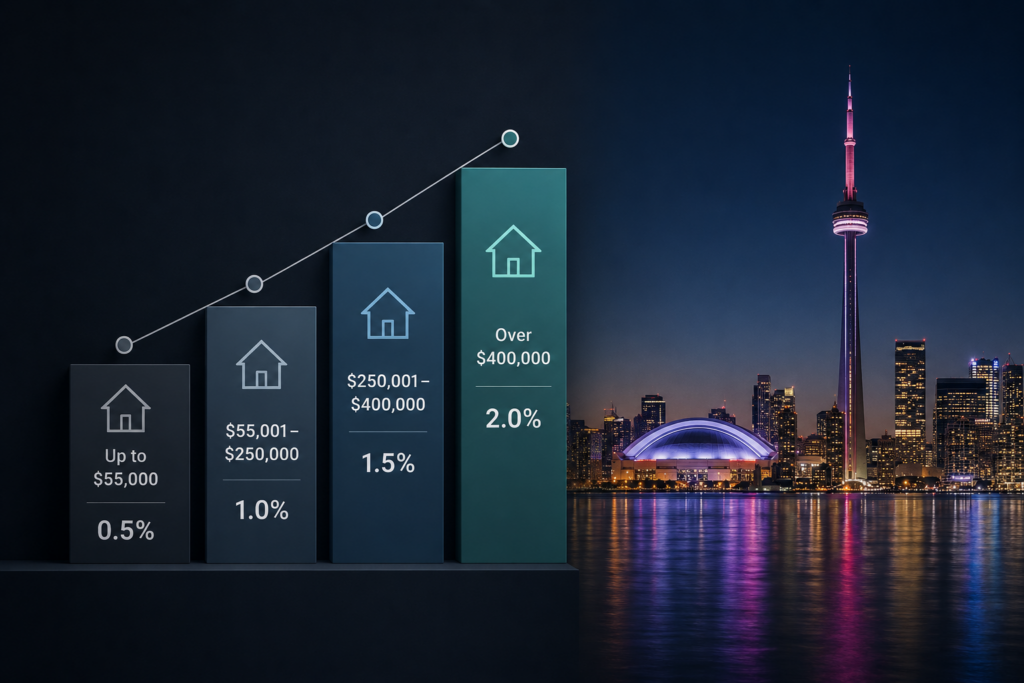
Land transfer tax is not a legal fee — it is a government tax your lawyer collects and remits on your behalf — but it is almost always the largest single number on a purchase, so it belongs in any honest breakdown. Ontario’s provincial land transfer tax is marginal, meaning each portion of the price is taxed at its own rate:
| Portion of purchase price | Ontario LTT rate |
|---|---|
| Up to $55,000 | 0.5% |
| $55,001 – $250,000 | 1.0% |
| $250,001 – $400,000 | 1.5% |
| $400,001 – $2,000,000 | 2.0% |
| Over $2,000,000 | 2.5% |
If the property is inside the City of Toronto, you pay a second Municipal Land Transfer Tax (MLTT) on top of the provincial one, using the same tiered structure — effectively doubling the tax. Surrounding municipalities such as Mississauga, Markham and Vaughan do not charge it. As of April 1, 2026, the City also introduced higher graduated MLTT rates on the portion of the price above $3 million for luxury homes. You can confirm current rates on the City of Toronto’s MLTT page.
A quick example. On a $1,000,000 Toronto home, the provincial LTT is about $16,475 and the municipal LTT is about the same — roughly $32,950 combined, payable in cash on closing and separate from your down payment.
First-time buyers can claw a meaningful amount back. Ontario offers a provincial rebate of up to $4,000, and the City of Toronto adds a municipal rebate of up to $4,475 — a combined saving of up to $8,475. To qualify, you generally must be a Canadian citizen or permanent resident, at least 18, and never have owned a home anywhere in the world. Your lawyer applies the rebate at registration so you pay the reduced amount at closing rather than waiting for a refund.
Standard flat fees assume a straightforward file. Certain situations legitimately add work, and therefore cost:
A reputable firm will flag any of these before starting work and get your agreement before charging for anything outside the original scope.
This is the part that saves people the most money and stress, so it is worth slowing down on. So many firms advertise “cheap rates” to win the click, then tag on fee after fee that was never mentioned up front. A $499 “legal fee” that quietly excludes title insurance, registration and software charges can land closer to $1,800 once everything is added at closing — by which point you are committed and it is too late to shop around. A slightly higher quote that bundles those costs honestly is very often cheaper overall, and far more predictable.
As covered above, this is exactly why the Law Society of Ontario requires advertised fixed prices to be all-inclusive: it exists to protect you from precisely this bait-and-switch. Before you retain anyone, ask four plain questions and get the answers in writing:
If a firm cannot or will not answer those clearly, treat the low number with suspicion.
Price is only half the question. The other half is who is actually doing the work — and this is something buyers rarely think to ask. Cheaper does not always mean better. To keep advertised rates low, some firms outsource the management and preparation of files outside of Canada, which can mean your transaction, and your personal and financial information, is being handled by people who are not part of the Canadian firm you hired and are not accountable to the Law Society of Ontario.
Your home is likely the largest transaction of your life, and the details matter. Take a moment to study the firm and ask direct questions: Will my file be handled here, in your office, by your own team? Who will I actually be dealing with? Who prepares my closing documents? A firm that keeps your file in-house, with clear accountability from start to finish, is worth more than a rock-bottom rate where you never quite know whose hands your file is passing through.
At Wannes Law, we quote real estate transactions as a transparent, all-inclusive flat fee with disbursements itemised up front, and your file is handled in-house by our own team from the first call to closing. The number you see is the number you pay, and you always know exactly who is looking after your transaction. If you are buying, selling or refinancing in Toronto or across Ontario, request your flat-fee quote today and we will walk you through every line before you commit.
This article is general information, not legal advice. Land transfer tax rates, rebates and fees can change — confirm the figures that apply to your purchase with your lawyer and, where relevant, Ontario’s Ministry of Finance.
Real estate lawyer disbursements are third party costs that your lawyer pays to complete your transaction. The legal fee covers the firm's own work.…

A real estate lawyer’s work begins long before closing day — and continues after you have access to the property. Most buyers know they…

A status certificate review by a real estate lawyer is one of the most important steps in any condo purchase in Ontario.