

Packages
Four will packages, and who each one suits
Every package includes estate planning advice from Rosalie Wannes, a lawyer licensed by the Law Society of Ontario. The difference between them is what gets drafted, not how much care goes into it.
-
Will
Your will on its own: who receives what, who acts as your estate trustee and backup, and who you would want to look after your children. It suits someone who already has up-to-date powers of attorney, or who wants to put the will in place first. If you have no powers of attorney, the single will package usually makes more sense, because the will does nothing while you are alive.
$750 + HST -
Single will package
Your will plus a continuing power of attorney for property and a power of attorney for personal care. This is the complete plan for one person: the will covers what happens after death, and the two powers of attorney cover a period of illness or incapacity before it. It suits most single adults, widowed parents and people who have separated.
$1,000 + HST -
Couples wills
Separate wills for two spouses or partners, usually with matching terms, and both powers of attorney for each of you. It suits couples whose plans are aligned, such as leaving everything to each other and then to the children. If either of you has children from an earlier relationship, we look carefully at whether matching wills really protect everyone (see below).
$1,750 + HST -
Primary & secondary wills
Two wills that work together, plus both powers of attorney. It suits people who own assets that can usually be transferred without probate, most often shares in a private corporation. The point is to keep those assets out of the estate administration tax calculation. The section on two wills below shows when the saving justifies the extra cost, and when it doesn’t.
$2,500 + HST
How it works
What happens at your instructions meeting, and after
Most of the value in a lawyer-drafted will comes from the conversation before anything is written down.

-
Step 1: Choose a package and book
Pick a package in the quote form and the price is shown before you book. Not sure which one fits? A free 15-minute call is enough to decide.
-
Step 2: The instructions meeting
We go through your family, including any children from earlier relationships and anyone who depends on you financially, and everything you own and how it is held: in your name alone, jointly, through a corporation, or with a named beneficiary. We ask who you want as estate trustee and as a backup, who should care for young children, at what age children should receive their inheritance, and whether a married spouse or a dependant could have a claim that your will has to allow for. You give instructions yourself, so that there is no later question about whose wishes the will reflects.
You provide
- Full names of the people you want to name or benefit
- A rough list of assets and debts, and how each is held
- Any marriage contract, separation agreement or support order
- Beneficiary designations on RRSPs, RRIFs, TFSAs, pensions and insurance, if you have them
We handle
- Estate planning advice
- Flagging spousal, dependant and tax issues
-
Step 3: Review the drafts
You receive drafts in plain language. We walk through what each clause does, including the ones people tend to skip, such as the powers you give your estate trustee and what happens if a beneficiary dies before you.
-
Step 4: Sign with two witnesses
You sign at our Toronto office on Sheppard Ave E in front of two witnesses, as Ontario law requires, and the lawyer confirms you understand the documents and are acting freely. A home or hospital visit in the GTA is available only where a medical or mobility reason makes coming in difficult.
Home or hospital visit: $500 + HST.
Why Wannes Law
A Toronto law firm that keeps you informed
-
A licensed Ontario lawyer
Rosalie Wannes, licensed by the Law Society of Ontario, is responsible for your file from start to finish.
-
Fees before you commit
Instant online quotes and published flat fees, so you know the cost before you retain us.
-
Every step explained
Plain-language explanations of what happens, what you provide and what we handle, at every stage.
-
Direct access
Reach your lawyer and law clerk directly by phone and email while your matter is underway.
-
Sign in person or remotely
Meet at our Sheppard Ave E office in Toronto, or review documents by video and courier the originals.
-
English, Armenian and Arabic
Talk through your matter in the language you are most comfortable with.
Secondary wills
When two wills make sense
Ontario charges estate administration tax only on the assets that go through a probate application. A second will keeps assets that don’t need probate out of that calculation.
How it works
You sign two wills on the same day. The primary will deals with assets that banks, the Land Registry and other institutions usually won’t release without a court certificate: your home and other Ontario real estate, bank and investment accounts in your name alone. The secondary will deals with assets that can usually be transferred on the strength of the will itself. When you die, your estate trustee applies to court only on the primary will. Ontario’s estate administration tax rules confirm that where the court issues a certificate limited to the assets in one will, only those assets are counted in the value of the estate.
What suits a secondary will
- Shares in a private corporation, such as a holding company or the company that runs your business, where the directors can register a transfer without seeing a court certificate
- Money the corporation owes you, such as a shareholder loan
- Personal and household belongings, vehicles of modest value and similar property that seldom needs probate
Before relying on it, we check the company’s articles and any shareholder agreement, because they can restrict how shares pass on death. Our business law page explains share structures and minute books.
Drafting so the wills don’t cancel each other
Under Ontario’s Succession Law Reform Act, a later will can revoke an earlier one. Each will therefore needs a revocation clause that expressly leaves the other in place, a clear definition of which assets it covers, and a residue clause that catches anything missed without swallowing the other will’s assets. The two usually name the same estate trustee, and both originals must be kept safe.
A worked example (as of 2026)
| Asset at death | One will | Two wills |
|---|---|---|
| Scarborough home, $1,100,000 less $300,000 mortgage | $800,000 | $800,000 |
| Bank and investment accounts in own name | $150,000 | $150,000 |
| Shares of a private holding company | $900,000 | not counted |
| Value for the tax | $1,850,000 | $950,000 |
| Tax: $15 per $1,000 above $50,000 | $27,000 | $13,500 |
Here the second will saves $13,500 in tax, against a package that costs $1,500 + HST more than the single will package. RRSPs, RRIFs and insurance with a named beneficiary are left out in both columns, because they pass outside the will.
When it isn’t worth it
If you don’t own private company shares or other assets that can move without probate, a second will saves nothing. If those assets are worth around $100,000, the tax saved is about $1,500, roughly the extra cost. And if a buyer or institution later insists on probate for a secondary-will asset, it can still be probated, with tax on that asset. For many people a single will is the right answer, and we tell you so.
Couples
Couples and mirror wills: how they work and where they go wrong
Couples wills (often called mirror wills) are two separate wills with matching terms. Each of you signs your own, and each can be changed on its own.

The usual pattern
Each spouse leaves everything to the other, and if the other has already died, to the children or other beneficiaries you have chosen together. Each will names the same estate trustees and the same guardian for young children. That last point matters: under Ontario’s Children’s Law Reform Act, if parents die at the same time and name different guardians, only the people named by both parents are effective.
If you die together
Where it is uncertain which spouse died first, the Succession Law Reform Act treats each person’s property as passing as if they had survived the other. Couples wills usually add a survivorship clause, requiring a beneficiary to outlive you by a set period, commonly 30 days, so that the property doesn’t pass through two estates, with two sets of costs, only to end up in the same place.
The risk: the survivor can change everything
Mirror wills are not a contract. After the first death, the survivor owns what was left to them and can make a new will leaving it to anyone, including a new partner. Couples who want to bind each other would need a separate agreement not to change their wills, which is rare, restrictive and hard to undo. In a second marriage or blended family, the more common protections are a trust that supports the surviving spouse for life and then passes to the first spouse’s children, a direct gift to children at the first death, or life insurance for one side of the family.
Spousal rights still apply
A married spouse can choose an equalization of family property instead of what the will leaves them, and a dependant can claim support. Our wills and estates overview explains both claims; we check for them before drafting.
Young children
Guardians and trusts for minor children
For parents of young children, the will answers two separate questions: who raises them, and who manages their money.

Naming a guardian
Your will can appoint someone to have decision-making responsibility for your children. The person must agree, the appointment only takes effect if no other parent with decision-making responsibility survives you, and it lasts 90 days, during which the person must apply to court. The court decides based on your children’s best interests, and a clear choice in your will carries weight. Name a backup, and talk to both before we draft.
Why a trust matters
An inheritance left outright to a minor can’t simply be handed to the child. Ontario law lets a parent or caregiver receive only a small amount on a child’s behalf, up to a limit set by regulation. Above that, as Ontario’s guardianship guidance explains, money payable to a child is in most cases paid into court unless someone applies to be appointed guardian of the child’s property. Either way, the child receives everything at 18.
What a testamentary trust lets you decide
- The age: the trust can hold a child’s share until 21, 25 or another age you choose, or pay it out in stages.
- What it can be used for: your trustee can pay for housing, education, activities and support along the way.
- Who controls the money: it can be the guardian or someone else. Separating the roles gives the children a second adult watching out for them.
Insurance and registered plans
Naming a minor directly as beneficiary of life insurance or an RRSP creates the same problem. We look at your designations so that money for children goes into the trust in your will or to a trustee you have named for them.
After signing
Signing, storing and keeping your will current
A will that is properly signed but can’t be found, or that no longer fits your family, causes the same problems as having no will.
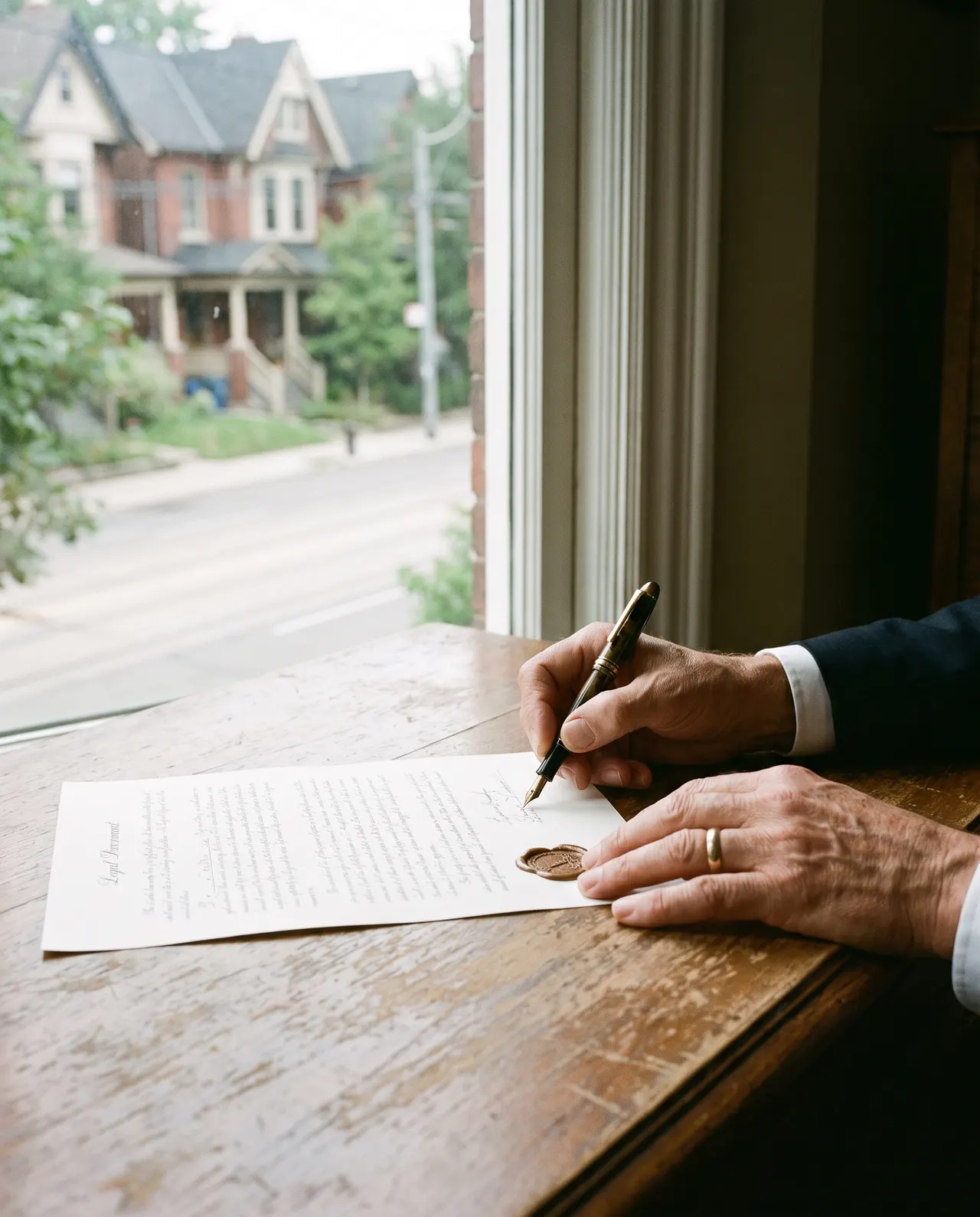
Signing day
- Bring valid government-issued photo ID
- You and two witnesses sign at the same time; witnesses should not be beneficiaries or their spouses, or those gifts can fail
- Don’t staple, unstaple or write on the original afterwards; changes need a codicil or a new will signed with the same formalities
Storing the original
- Probate needs the original signed will, not a copy
- Keep it somewhere safe and fireproof, and tell your estate trustee where it is
- Under Ontario’s Estates Act, the local Superior Court of Justice office can hold a will for safekeeping during your lifetime, for a small court fee
- A missing original can be presumed revoked, forcing your family into a court application
When to update
- Marriage, separation, divorce or a new partner (marriage no longer revokes an Ontario will)
- A birth, a child turning 18, or a beneficiary who needs support
- Buying or selling a home, or starting a corporation
- Your estate trustee or guardian can no longer act
- Every few years in any case, alongside your beneficiary designations
Our step-by-step guide to writing a will covers what to think about before your meeting.
Flat fees
Will package prices
Every package includes basic estate planning advice.
A home or hospital visit in the GTA adds $500 + HST, available where a medical or mobility reason makes coming in difficult. The person making the will must have full mental capacity. Services in English, Armenian and Arabic. See all our legal fees.
Get your instant quoteQuestions
Questions about wills

Which will package should I choose?
If you have no powers of attorney, choose the single will package ($1,000 + HST) or, for two spouses, couples wills ($1,750 + HST). The will alone ($750 + HST) suits someone whose powers of attorney are already current. Primary and secondary wills ($2,500 + HST) are for people who own private company shares or similar assets worth enough for the tax saving to matter.
How much can a secondary will save?
Estate administration tax is $15 for every $1,000 above $50,000 (as of 2026). Every $100,000 of assets moved into a secondary will saves $1,500 of tax. On $900,000 of company shares the saving is $13,500.
What is the difference between couples wills and mirror wills?
They describe the same thing: a separate will for each spouse, with matching terms. Each spouse can change their own will at any time, including after the other has died.
Can I change my will after it is signed?
Yes, while you have capacity. Small changes can be made with a codicil, a short document signed with the same formalities as a will. Larger changes are usually cleaner in a new will. Handwritten notes on the original don’t work and can cause disputes.
Where should I keep my original will?
Somewhere safe that your estate trustee knows about. You can also deposit it with the Superior Court of Justice for safekeeping. Probate requires the original, so a lost original can mean a court application.
Can I leave money to my grandchildren or young children?
Yes. A trust in your will lets your estate trustee hold the money, spend it on the child’s needs and pay it out at an age you choose. Without one, most money for a minor is paid into court and released in full at 18.
Can someone visit my parent at home or in hospital?
Yes, in the GTA, where a medical or mobility reason makes coming in difficult. It adds $500 + HST. Your parent must have the mental capacity to make a will, and the lawyer needs to take instructions from them directly.
What happens to my will when I die?
Your estate trustee finds the original, decides whether probate is needed and administers the estate. Our probate and estate administration page explains that process, and our guide on what to do when someone dies in Ontario covers the first weeks.
Related
Related
Areas We Serve
Serving clients across Toronto and the GTA
From our Toronto office we act for clients across the Greater Toronto Area, including Durham, York and Peel regions: Markham, Richmond Hill, Pickering, Ajax, Whitby, Oshawa, Mississauga and Brampton.
-
Scarborough
Wills & powers of attorney for Scarborough clients. Our office is on Sheppard Ave E.
-

North York
Wills & powers of attorney for North York clients.
-

Markham
Wills & powers of attorney for Markham clients.


Here to help
Choose a package and book the call.
The price is shown before you book.
Prefer to talk now? Call (647) 707-7718 · Service in English, Armenian and Arabic